
Backups Are Not Resilience: What Leaders Should Ask Before an Incident
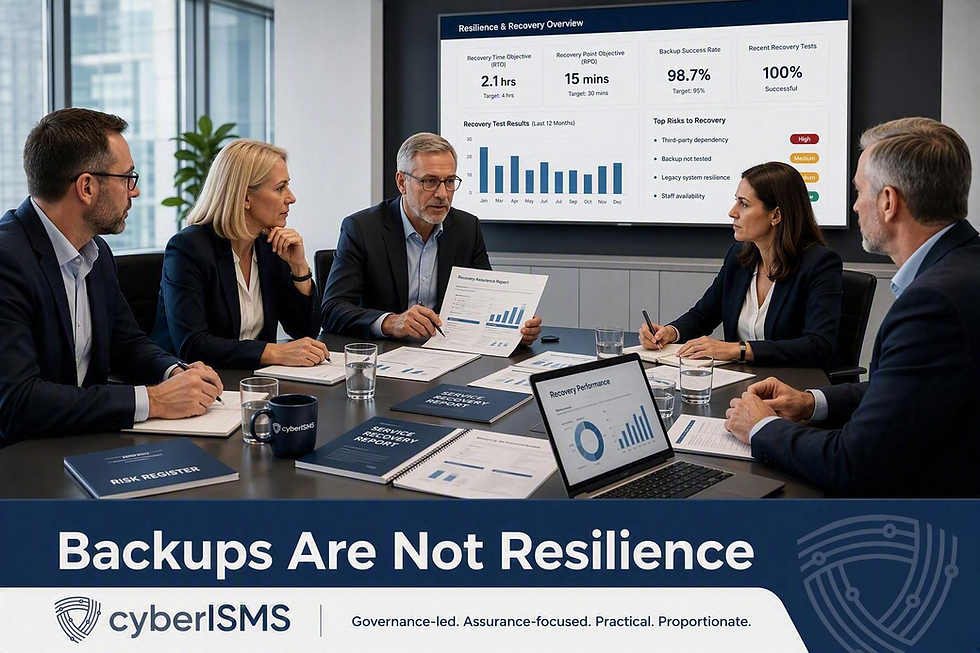
For many organisations, the question of resilience appears straightforward:
"We have backups. Therefore we're protected."
Unfortunately, that assumption has been challenged repeatedly by ransomware incidents, infrastructure failures, supplier outages, and operational disruptions.
Having backups is important. However, backups alone do not guarantee recovery.
The real test comes when an organisation needs to restore systems, recover data, resume services, and maintain operations under pressure.
The uncomfortable truth is that many leadership teams have never seen evidence that recovery will work when it matters most.
That distinction separates backup capability from genuine resilience.
Why This Matters
Regulated organisations face increasing expectations around operational resilience, cyber resilience, governance, and accountability.
Whether responding to a cyber incident, accidental deletion, infrastructure failure, or supplier disruption, leadership teams are expected to demonstrate that critical services can be restored within acceptable timeframes.
Auditors, customers, insurers, regulators, and boards are increasingly asking similar questions:
How quickly can services recover?
Which systems are most critical?
When was recovery last tested?
What evidence supports recovery claims?
Who is accountable for recovery outcomes?
Having a backup solution is not enough if the organisation cannot confidently answer those questions.
Resilience requires proof.
Where Organisations Go Wrong

Many organisations invest heavily in backup technology but pay significantly less attention to recovery assurance.
Common weaknesses include:
Assuming Backup Equals Recovery
Successful backup reports often create a false sense of security.
A backup may complete successfully while underlying recovery issues remain undiscovered.
Problems often emerge only when a restore attempt is made during a live incident.
Limited Restore Testing
Few organisations regularly perform realistic restore exercises.
Testing may be limited to a single file recovery or performed only during annual audits.
This rarely reflects the complexity of restoring business-critical systems under operational pressure.
Unclear Recovery Objectives
Recovery Time Objectives (RTOs) and Recovery Point Objectives (RPOs) are often undefined, undocumented, or disconnected from business priorities.
Without clear objectives, it becomes impossible to determine whether recovery arrangements are actually sufficient.
Lack of Executive Visibility
Boards frequently receive reports about backup success rates but little information about recovery effectiveness.
Leadership may therefore have confidence in backup controls without assurance of actual resilience.
The Governance Implications
Cyber resilience is no longer solely an IT responsibility.
It is a governance issue.
Leaders are accountable for understanding risks to critical services and ensuring appropriate controls operate effectively.
From a governance perspective, key questions include:
Which business services are most important to customers and operations?
What recovery commitments have been defined?
When was recovery capability last tested?
What lessons were identified?
Are recovery outcomes reported to leadership?
Is there evidence that recovery objectives can be achieved?
These questions align closely with the principles of continual improvement, risk management, accountability, and assurance found across recognised frameworks such as ISO/IEC 27001, ISO/IEC 20000-1, NCSC guidance, Cyber Essentials Plus, and UK GDPR resilience expectations.
What Good Looks Like

Organisations seeking genuine resilience move beyond backup administration and adopt a structured recovery assurance approach.
Practical controls include:
Regular Recovery Testing
Conduct planned restore exercises for critical systems and services.
Test entire recovery processes, not just individual files.
Defined Recovery Objectives
Establish documented RTOs and RPOs linked to business requirements.
Ensure leadership understands and approves recovery priorities.
Recovery Evidence and Reporting
Produce objective evidence demonstrating that recovery activities have been tested and validated.
Report outcomes through governance forums.
Incident Response Integration
Ensure backup and recovery arrangements form part of wider incident response and business continuity activities.
Recovery should not exist in isolation.
Continual Improvement
Review test results, identify gaps, assign actions, and measure progress over time.
Resilience improves through repetition and learning.
Governance-Led Recovery Confidence

The most resilient organisations are not those with the largest backup platforms.
They are the organisations that can confidently demonstrate recovery capability.
Confidence comes from evidence.
Evidence comes from testing.
Testing creates assurance.
And assurance enables boards to make informed decisions about risk, investment, and operational resilience.
At cyberISMS, we help organisations move beyond technology-focused backup conversations towards governance-led resilience, supporting recovery assurance, operational readiness, risk visibility, and continual improvement in line with recognised best practice.
Our approach emphasises evidence, accountability, and measurable resilience outcomes rather than assumptions.
Final Thought
Before the next incident occurs, leadership teams should ask a simple question:
"Do we know our backups exist, or do we know we can recover?"
The answer may reveal whether your organisation has a backup strategy or a resilience strategy.
Call to Action:
If you'd like an objective review of your recovery assurance capability, backup testing programme, or resilience governance reporting, speak with cyberISMS about strengthening recovery confidence before an incident tests it for you.


Comments