
Are You Incident Ready - or Just Hoping?
Ransomware attacks and data breaches are no longer exceptional events.
For regulated organisations such as accountancy firms, legal practices, and education providers, cyber incidents are now considered an operational certainty that must be planned for, rehearsed, and governed accordingly.
The real question is no longer whether an incident will occur — but whether your organisation is genuinely incident ready, or simply hoping nothing happens tomorrow.
Incident readiness is about far more than restoring systems after an attack. It is about demonstrating control, coordination, evidence, and defensible decision-making under pressure.
This article explores what incident readiness looks like in practice, including tabletop exercises, communications planning, evidence preservation, and the expectations insurers and regulators increasingly have following a cyber incident.

Understanding Incident Readiness
Incident readiness means having a clear, tested, and rehearsed capability to respond to a cyber incident effectively under pressure.
It goes far beyond:
hoping systems are secure,
relying on informal knowledge,
or assuming people will “do the right thing” during a crisis.
For regulated organisations, incident readiness is no longer optional.
Regulators expect timely reporting, clear decision-making, and demonstrable evidence.
Insurers increasingly expect proof of preparedness before validating claims.
Good incident readiness means:
knowing who does what during an incident across technical, leadership, legal, and communications teams,
having defined escalation and communication paths,
capturing evidence as the incident unfolds,
documenting decisions clearly,
and regularly testing response processes before a real incident occurs.
Incident Readiness Is Not Just Technology
Many organisations assume cyber readiness is achieved through:
antivirus,
backups,
cyber insurance,
or outsourced IT support.
These controls are important — but they do not guarantee an effective response under pressure.
In reality, the organisations that struggle most during incidents are often not those with the weakest technology, but those with unclear ownership, poor communication, inconsistent decision making, or inadequate evidence handling.
Incident readiness is ultimately about:
coordination,
accountability,
communication,
governance,
and operational resilience.
Technology supports the response — but it does not replace preparation.
Why Tabletop Exercises Matter
Tabletop exercises are one of the most effective — and most underused — tools for improving incident response readiness.
They simulate a ransomware or breach scenario in a controlled environment, allowing teams to walk through decisions, escalation, communication, and recovery without real-world consequences.
Common tabletop scenarios include:
ransomware encryption spreading across shared systems,
compromised Microsoft 365 accounts,
supplier breaches affecting client data,
accidental disclosure of sensitive information,
or loss of access to critical business platforms.
A well-run tabletop exercise should test:
Detection and containment — how quickly a threat is recognised and isolated
Decision making — who is involved, what authority they hold, and how decisions are documented
Communications — how information flows between IT, leadership, legal advisers, insurers, regulators, and clients
Evidence handling — whether logs, timelines, and actions are captured in a defensible manner
Recovery strategy — whether systems are restored, rebuilt, isolated, or escalated appropriately
Most organisations believe they are ready — until they run a tabletop exercise.
The gaps exposed are almost always process, ownership, and coordination gaps rather than purely technical ones.
That is precisely why rehearsing matters.

Building a Clear Communications Plan
During a cyber incident, silence and confusion often cause more damage than the incident itself.
A clear, pre-agreed communications plan should define:
who communicates internally and externally,
what is communicated, when, and to whom,
how regulators and insurers are notified,
how client messaging is managed,
and how media or public enquiries are handled.
In regulated sectors, communication timelines matter.
Delays, inconsistent messaging, or informal updates can quickly escalate legal, contractual, and regulatory risk.
Mature incident response plans also define out-of-band communication methods in case primary systems, such as email or collaboration platforms, become unavailable during an incident.
Having pre-approved templates, escalation paths, and decision trees allows organisations to respond calmly, consistently, and compliantly — even under pressure.
Collecting and Preserving Evidence
Evidence is often the weakest part of incident response — and one of the most heavily scrutinised afterwards.
Good incident readiness ensures evidence is:
captured as part of the response, not reconstructed later,
preserved securely to avoid contamination or loss,
clearly time-sequenced,
and documented in a way that demonstrates accountability and traceability.
Typical evidence includes:
system and security logs,
incident tickets and timelines,
communications and approvals,
screenshots and forensic artefacts,
recovery records,
and post-incident reviews and lessons learned.
Evidence handling should also maintain clear integrity and chain-of-custody principles, particularly where forensic investigation, insurer review, or legal scrutiny may follow.
This evidence supports:
insurer claims,
regulator notifications,
internal assurance activities,
contractual obligations,
and, where necessary, legal defence.
Without reliable evidence, organisations often struggle to demonstrate that appropriate actions were taken during the incident.

Meeting Insurer and Regulator Expectations
Insurers and regulators are increasingly aligned in what they expect organisations to demonstrate following a cyber incident.
They look for evidence that:
an incident response plan exists and is current.
roles and escalation paths are clearly defined,
incident response exercises are conducted and documented,
decisions are recorded and justified,
recovery procedures are tested,
and lessons learned feed into continual improvement.
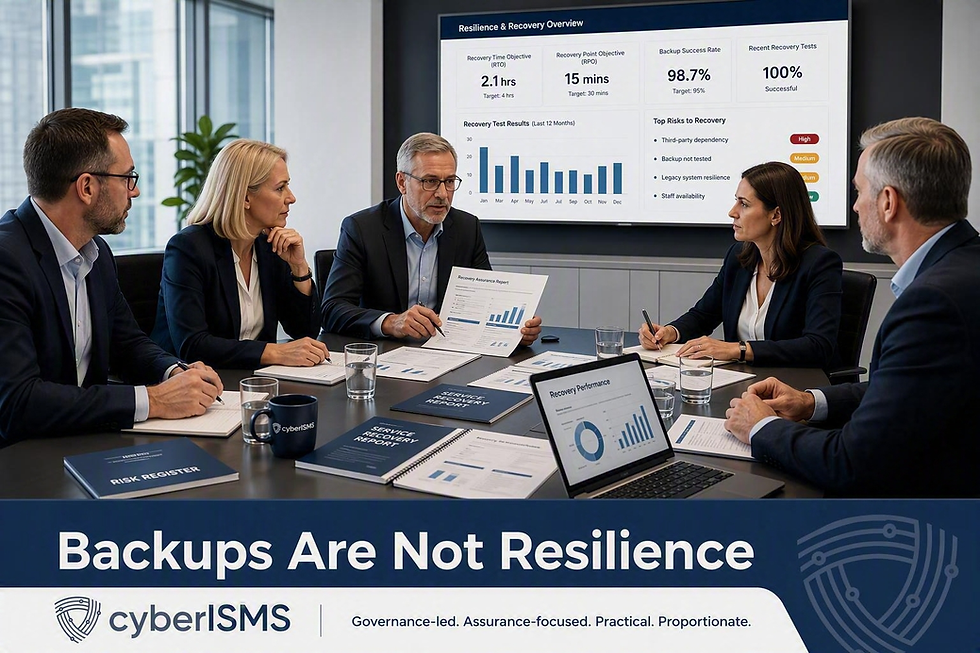
Increasingly, organisations are also expected to demonstrate that backups and recovery processes are not only in place but are regularly validated against operational recovery objectives.
Organisations that cannot demonstrate this often face:
delayed or reduced insurance payouts,
increased regulatory scrutiny,
reputational damage,
contractual complications,
and loss of client confidence.
Incident readiness is no longer about reacting quickly.
It is about responding in a way that stands up to scrutiny afterwards.
Taking the Next Step
Most organisations only discover how unprepared they are after an incident has already disrupted operations.
Incident readiness is not about fear or panic.
It is about preparation, confidence, and operational resilience.
It ensures that when something does happen, your organisation can respond decisively, lawfully, and defensibly.
If you have not recently:
run a tabletop exercise,
reviewed your incident response communications,
tested your recovery processes,
or validated your evidence capture approach,
Now is the time.
Start by rehearsing.
Then fix what the rehearsal exposes.
At cyberISMS, we help regulated organisations strengthen incident readiness through practical tabletop exercises, governance-focused response planning, communications preparation, and defensible evidence processes designed to withstand insurer, client, and regulatory scrutiny.
If you would like an independent sense-check of your current incident-readiness posture, speak to cyberISMS.


Comments