
Why IT Risk Still Surprises Leaders — and How Better Governance Prevents It
Across UK‑regulated sectors — from accountancy and legal practices to schools and academy trusts — information and cyber risk are formally recognised as board‑level concerns. Yet leaders are still frequently surprised by IT incidents that disrupt services, undermine confidentiality or availability, and attract regulatory scrutiny.
What’s notable is that these incidents rarely result from unforeseen threats. More often, they stem from known risks that were not clearly identified, owned, assessed, or escalated in line with the organisation’s risk appetite.
So why does this persist — and what governance arrangements actually provide early warning and assurance?
This article examines the root causes of unexpected IT incidents and outlines governance practices that complement baseline technical controls such as Cyber Essentials, while aligning with ISO‑based management systems.

Why IT Risk Escapes Board Oversight
Boards reasonably expect timely visibility of material risks. IT risk frequently falls short of this expectation due to a small number of systemic governance weaknesses.
Complex risk landscapes
Modern IT environments consist of cloud services, on‑premise systems, third‑party suppliers, remote access, and regulatory obligations. Risk is distributed across assets, services, and suppliers. Without a structured risk framework, oversight becomes fragmented.
Unclear risk ownership
Where accountability for identifying, maintaining, and escalating IT risks is not explicitly assigned, risks tend to be managed informally. They often remain below reporting thresholds until an incident forces escalation.
Operational reporting instead of risk reporting
IT reports frequently describe activity rather than risk. Boards require impact‑focused, assurance‑based reporting that addresses likelihood, consequence, control effectiveness, and tolerance — not technical detail.
Change outpacing governance
Threat actors, supplier dependencies, and regulatory expectations evolve rapidly. Governance processes that are infrequent or compliance‑only quickly fall out of alignment with the risk environment.
Insufficient challenge and assurance
Where boards lack confidence in cyber and IT risk matters, challenge is reduced. Key questions about control effectiveness, residual risk, and assurance are not consistently asked.
Combined, these factors create governance blind spots where risk appears “sudden”, despite having existed for some time.
The role of a properly structured IT risk register
An IT risk register should be more than an administrative document. Used properly, it becomes a leadership tool.
A strong IT risk register is:
Comprehensive — covering cyber security, data protection, service resilience, third‑party dependency, and regulatory risk
Plain‑English — describing risks and impacts in business terms, not technical language
Prioritised — clearly identifying which risks genuinely threaten organisational objectives
Current — updated as systems, suppliers, and threats change
Owned — with named individuals accountable for each risk
For example, a professional services firm may track risks such as loss of client data, prolonged system outages, or failure to meet regulatory obligations. Each risk has a clear owner, defined tolerance, and agreed mitigation actions.
For leaders, this removes ambiguity. You can see what matters, who owns it, and whether risks are under control.
Making risk visible through dashboards
Boards don’t need to review risk registers line by line. What they need is visibility.
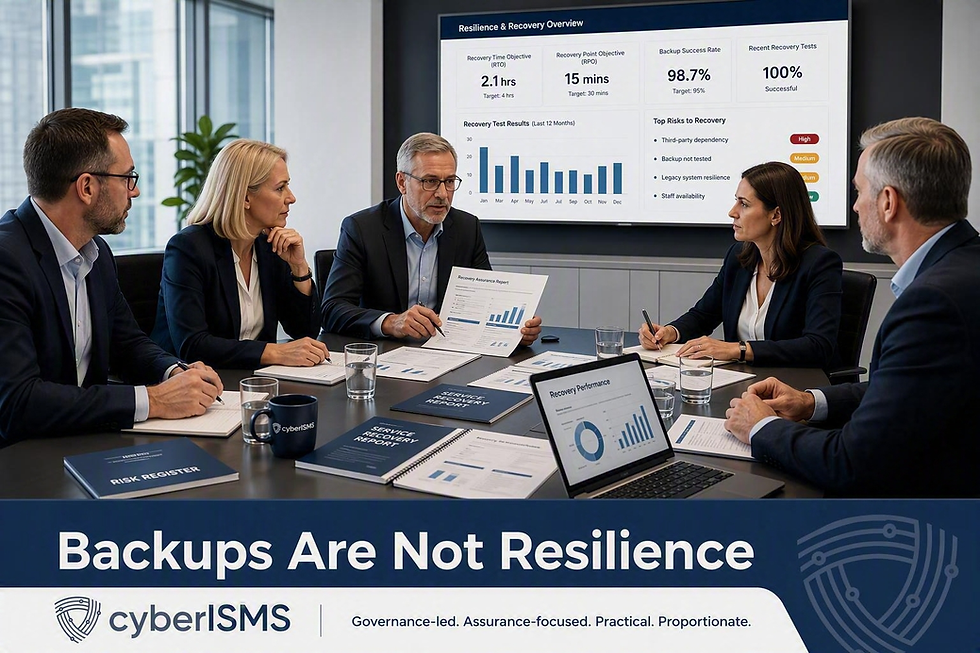
Dashboards translate detailed risk information into something leaders can quickly understand and challenge.
Effective IT risk dashboards typically:
Present a small number of key risk indicators with clear thresholds
Track progress against agreed mitigation actions
Highlight trends and emerging issues, not just the current status
Provide consistent reporting from meeting to meeting
For a school or academy trust, this might include system availability, safeguarding‑related IT risks, supplier assurance status, or incident trends over time.
Dashboards also support defensibility, demonstrating that risks are being actively monitored — something regulators and auditors increasingly expect.
Ownership: Where Governance Succeeds or Fails
Governance breaks down fastest where ownership is vague.
Every material IT risk should have:
A clearly named owner
Authority to act, not just report
Defined escalation routes
Clear expectations for review and update
In many organisations, technical risks fall to IT, while compliance or regulatory risks fall elsewhere. That can work — provided those hand‑offs are explicit, and oversight is coordinated.
What matters is that risks do not fall between roles, teams, or committees. Clear ownership turns awareness into accountability.

The questions boards should be asking
Strong governance isn’t about knowing all the answers. It’s about asking the right questions.
Boards overseeing IT risk should be able to ask:
What are our top IT risks right now — and why?
Which risks are within tolerance, and which are not?
Who owns each risk, and what assurance do we have that controls are effective?
What has changed since the last report?
Have there been any incidents or near misses?
How does IT risk affect our ability to meet strategic objectives?
When reporting supports these questions, conversations change. IT risk becomes something leaders actively govern, not something they are periodically briefed on.
Practical steps to reduce IT risk surprises
Strengthening IT risk governance does not require starting from scratch. Practical steps include:
Establishing a single, board‑recognised IT risk register
Defining ownership and escalation expectations
Introducing consistent dashboards for leadership review
Aligning IT risk reporting to business objectives
Reviewing governance structures against current threats and regulations
Using independent assurance to test whether controls work in practice
In summary
Leaders are rarely surprised by IT risk because they ignored it. More often, they are surprised because governance did not make risk visible, owned, or challengeable early enough.
Strong IT risk governance — built around clear ownership, structured reporting, and the right board‑level questions — reduces uncertainty and supports confident decision‑making.
That is the difference between reacting to incidents and governing risk.
A simple next step
If you’re unsure whether your current IT risk governance would withstand board-level challenge or regulatory scrutiny, a short, structured review can quickly highlight gaps.
At cyberISMS, we help leaders understand whether their IT risk governance is clear, owned, and defensible — without starting with tools or technology.


Comments